How to Read a Loan Estimate (and Look Past the Rate)
Last reviewed October 2026. This is based on the standard federal Loan Estimate form. Lender fees and policies vary, so ask your lender to explain any line you do not understand.
The short version
- A low rate can come with high costs. Compare what each loan costs in total, not just the rate.
- On page 2, compare Total Loan Costs (Section D) and any lender credits.
- On page 3, the “In 5 Years” figures show what each loan really costs over a typical stretch of time.
- Compare Loan Estimates for the same loan type, loan amount, and lock status.
What is a Loan Estimate?
A Loan Estimate is a standard three-page form that lenders must give you within three business days after you apply for a mortgage. Every lender uses the same layout, so you can compare offers side by side. It estimates your rate, payment, and costs. It is not an approval, and it is not a commitment to lend.
Getting Loan Estimates from two or three lenders, ideally on the same day, is a good way to make sure you are getting a fair deal.
See an example
Here is a simplified Loan Estimate, so you can see where each number lives. It is made up for illustration, has fewer lines than a real form, and uses the same figures as Offer B in the example further down: a $300,000 loan on a $375,000 home with 20% down. Tap a page to flip through it.
Loan terms
Projected payments
Costs at closing
- 1Interest rate and monthly principal and interest. The headline numbers, but not the whole story.
- 2Can it change after closing? Look for adjustable rates, prepayment penalties, and balloon payments.
- 3Estimated total monthly payment. It adds mortgage insurance and escrow, so it is closer to your real payment.
- 4Estimated closing costs. Loan costs plus other costs, minus lender credits. Page 2 has the details.
- 5Estimated cash to close. Your down payment plus closing costs, minus your deposit and any credits.
Loan costs
Other costs
Calculating cash to close
- 1A. Origination charges. The lender's own fees, and any points. Compare closely.
- 2B. Services you cannot shop for. Required services the lender chooses, like the appraisal.
- 3C. Services you can shop for. You can pick your own provider, such as for title services.
- 4D. Total loan costs. A + B + C. A key number for comparing lenders.
- 5E through H. Taxes, prepaids, escrow, and other items. These are mostly similar across lenders.
- 6J. Total closing costs and lender credits. Closing costs after any credits the lender gives you.
- 7Calculating cash to close. Closing costs plus your down payment, minus your deposit and credits.
In 5 years
Annual percentage rate (APR)
Total interest percentage (TIP)
Other considerations
- 1In 5 years. What you will have paid after five years, and how much of it paid down your loan. Subtract to see interest and costs.
- 2APR. Includes your interest rate and some fees, so it is higher than your rate. A big gap can mean heavy fees.
- 3TIP. Total interest compared with the loan amount. It leaves out most upfront fees.
- 4Other considerations. Notes on the appraisal, assumptions, late fees, refinancing, and servicing.
This is an illustration, not a real offer. A real Loan Estimate has more lines and details, and your lender's name and information. A real sample from the Consumer Financial Protection Bureau follows.
See a real one
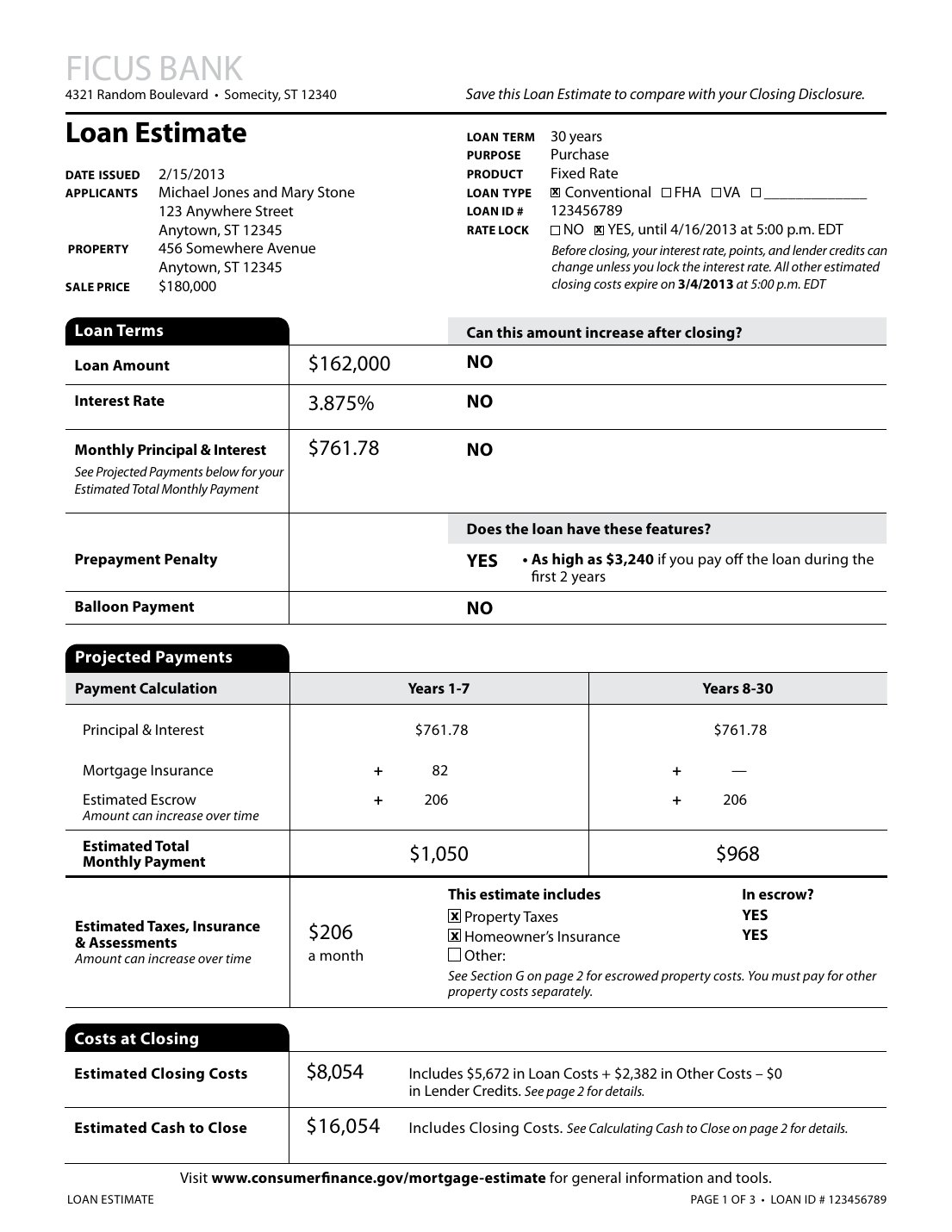
This is the Consumer Financial Protection Bureau's own sample Loan Estimate for a fixed-rate loan. The borrowers, lender, and addresses in it are fictional. The loan is $162,000 on a $180,000 home at 3.875% for 30 years, so its numbers are different from the example above. Tap a page to flip through it.
Source: Consumer Financial Protection Bureau, sample Loan Estimate (form H-24(B), fixed-rate loan), dated February 7, 2014. CFPB materials are U.S. government works and are generally in the public domain. The form can be updated over time, so ask your lender for your own.
What to notice in this sample
- The rate lock line (page 1, top right). It shows whether the rate is locked and until when. Here it is locked until a set date and time.
- The prepayment penalty (page 1). This loan has one: as much as $3,240 if you pay it off in the first two years. That is the kind of feature to ask about.
- Two payments, not one (page 1). The total monthly payment is $1,050 in years 1 through 7 and $968 from year 8, because the $82 of mortgage insurance drops off. Principal and interest alone is $761.78, so the real payment is about $288 higher.
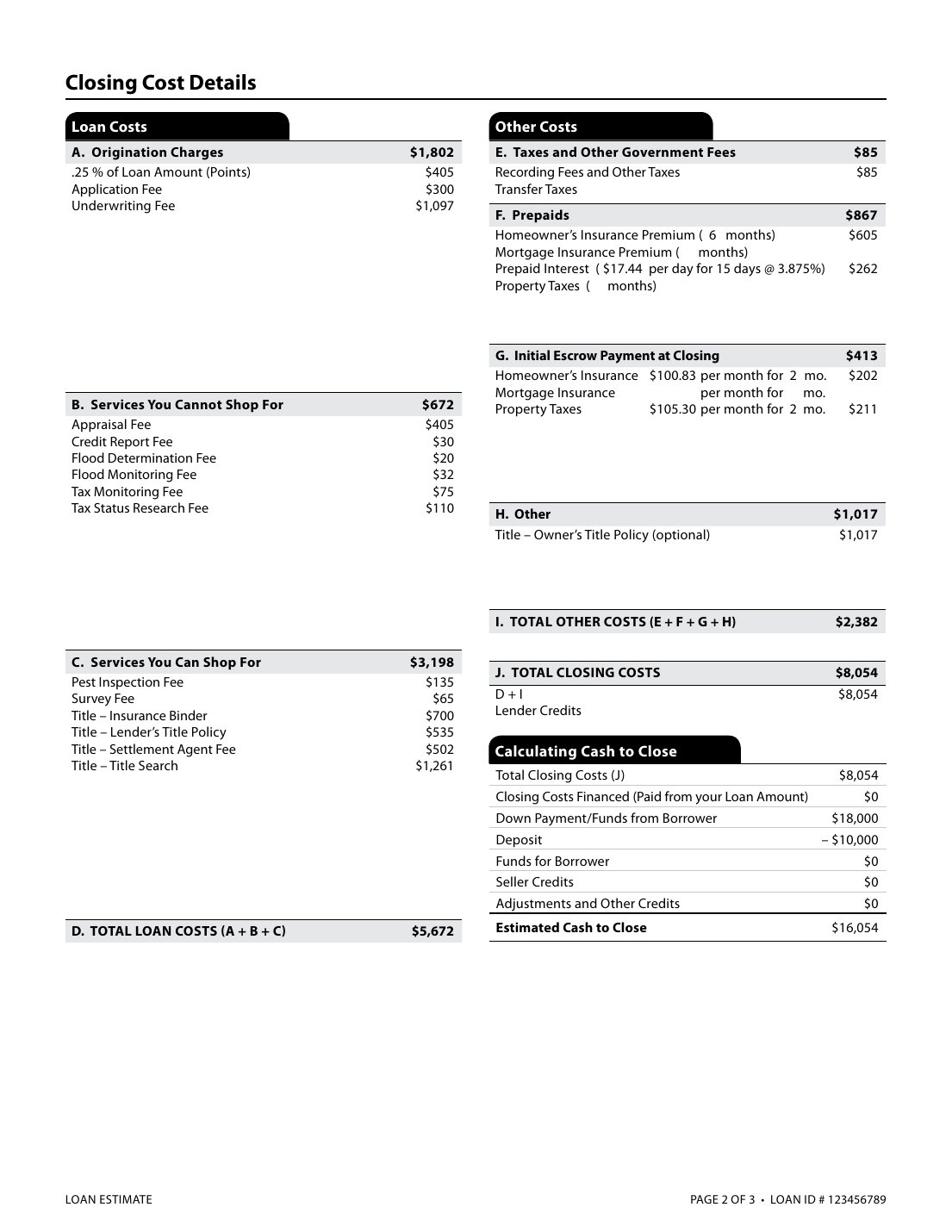
- Where the costs sit (page 2). Origination charges (A) are $1,802, including $405 for a quarter point. Services you can shop for (C) are the largest piece at $3,198, mostly title-related fees. Together with the services you cannot shop for (B), total loan costs (D) are $5,672.
- The cash to close math (page 2). Closing costs of $8,054, plus an $18,000 down payment, minus a $10,000 deposit already paid, gives $16,054.
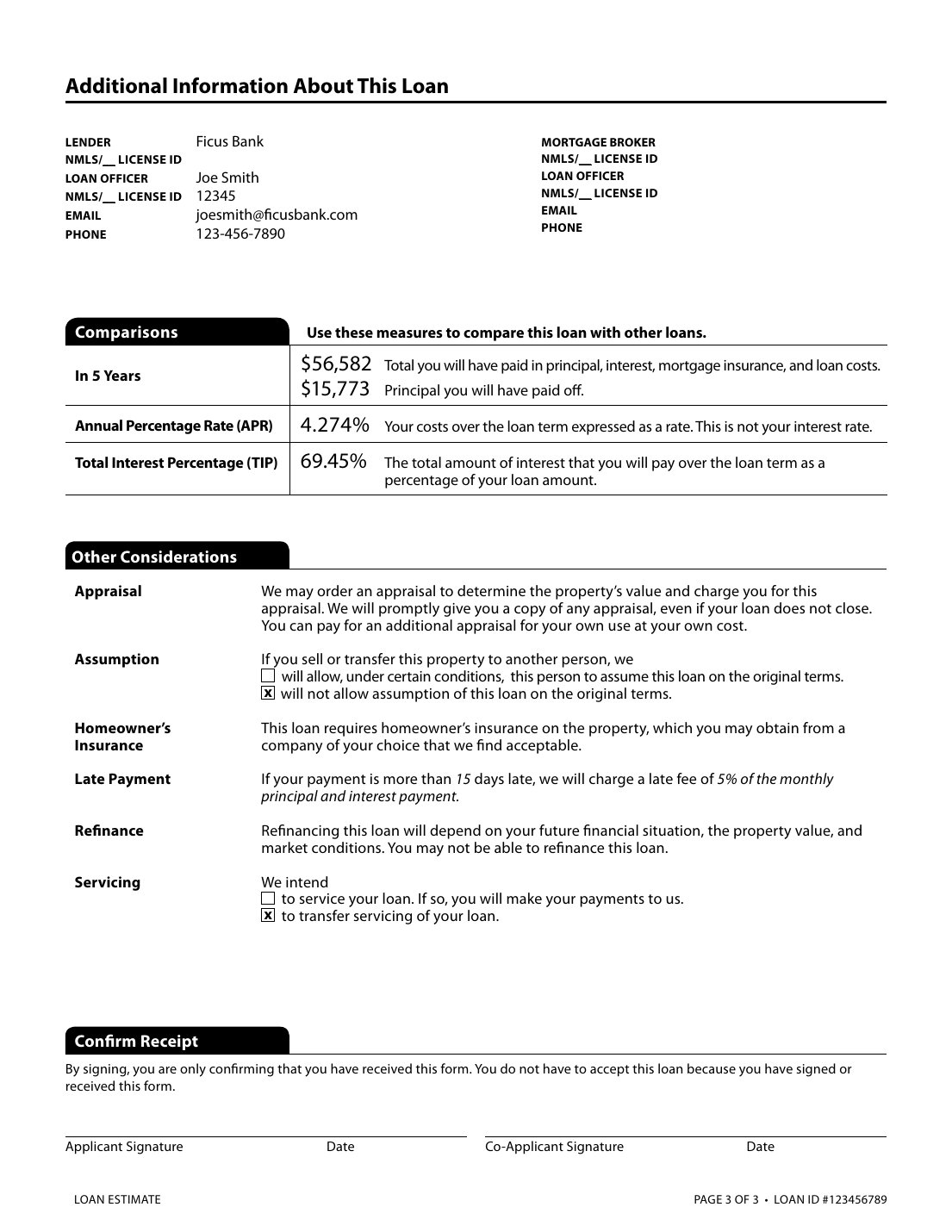
- The comparisons (page 3). After five years, this borrower would have paid $56,582, of which $15,773 is principal. That leaves about $40,800 in interest and costs. The APR is 4.274%, compared with the 3.875% rate, and the gap reflects fees and mortgage insurance.
- Servicing (page 3). The box is checked to transfer servicing, which means another company may collect your payments later.
Page 1: The snapshot
- Loan terms. The loan amount, interest rate, and monthly principal and interest, plus yes-or-no lines on whether these can change after closing. Look at whether the loan has a prepayment penalty or a balloon payment, and whether the rate is adjustable.
- Projected payments. Your estimated total monthly payment, which adds mortgage insurance and escrow for taxes and insurance to principal and interest. This is closer to what you will actually pay each month than the principal and interest figure alone.
- Costs at closing. Your estimated closing costs and your estimated cash to close, which is the money you need to bring.
A note on this page says your interest rate, points, and lender credits can change before closing unless you lock the rate. See rate locks for how that works.
Page 2: Where the costs are
This page breaks your closing costs into lettered sections. Some vary a lot from lender to lender, and some are set by your state, your county, or the property.
| Section | What it covers | For comparing |
|---|---|---|
| A. Origination charges | The lender's own fees, including any discount points you pay to lower your rate | Varies by lender. Compare closely. |
| B. Services you cannot shop for | Services the lender requires and chooses, such as the appraisal and credit report | Can vary by lender |
| C. Services you can shop for | Services where you may pick your own provider, such as title services or a survey. Your lender gives you a list of providers. | You can shop around |
| D. Total loan costs | A + B + C | A key number for comparing lenders |
| E. Taxes and other government fees | Recording fees and transfer taxes | Mostly set by your state and county |
| F. Prepaids | Items paid ahead of time, such as the first year of homeowners insurance and prepaid interest | Mostly similar across lenders |
| G. Initial escrow payment | A starting cushion for property taxes and insurance, held in your escrow account | Mostly similar across lenders |
| H. Other | Items such as an owner's title insurance policy | Depends on your situation |
| I. Total other costs | E + F + G + H | |
| J. Total closing costs | D + I, minus any lender credits | Your bottom-line closing costs |
Lender credits are money the lender gives back to offset your costs, usually in exchange for a higher interest rate. They show up in Section J. Below the lettered sections, Calculating Cash to Close starts with your total closing costs, adds your down payment, and subtracts your deposit, seller credits, and other credits to arrive at your estimated cash to close. For a planning estimate before you apply, try the cash to close estimator.
Page 3: The comparisons
- In 5 Years. Two numbers: the total you will have paid after five years in principal, interest, mortgage insurance, and loan costs, and the amount of principal you will have paid off. Subtract the second from the first to see how much you paid in interest and costs. Many borrowers sell or refinance within about five years, so this is a useful way to compare.
- Annual Percentage Rate (APR). Your costs over the loan term expressed as a yearly rate. It includes your interest rate and some of the fees, so it is higher than your rate. It is not your interest rate. A big gap between the two usually means significant fees or points. APR assumes you keep the loan for the full term, so it can overstate the cost if you move sooner, and it is less reliable when comparing an adjustable-rate loan with a fixed-rate loan.
- Total Interest Percentage (TIP). The total interest you will pay over the loan as a percentage of the loan amount. It leaves out upfront fees, other than prepaid interest, so on its own it can make a high-fee loan look good.
- Other considerations. Notes on the appraisal, whether the loan can be assumed by a buyer, homeowners insurance, late payment charges, what happens if you refinance, and whether your loan may be serviced by another company.
Why the rate alone can mislead
Lenders can trade rate for cost. Paying discount points (one point is 1% of the loan amount) lowers your rate but raises your costs. Taking a higher rate can earn a lender credit that lowers your costs. A “no-closing-cost” loan usually just has a higher rate. Neither choice is automatically better. It depends on how long you keep the loan. For more, see what discount points are and how they work.
Here is an example, for illustration only, of two offers on a $300,000 30-year fixed-rate loan:
| Offer A | Offer B | |
|---|---|---|
| Interest rate | 6.25% | 6.50% |
| Total loan costs (Section D) | $9,000 | $2,500 |
| Monthly principal and interest | $1,847 | $1,896 |
| Total paid in 5 years | $119,829 | $116,272 |
| Principal paid off in 5 years | $19,988 | $19,167 |
| Interest and costs over 5 years | $99,841 | $97,105 |
Offer A has the lower rate and the lower payment, which looks better at a glance. But after five years it has cost about $2,700 more in interest and costs than Offer B. Its payment is about $49 a month lower, and that takes roughly nine years to make up for the extra $6,500 in upfront costs. If you keep the loan for 10 years, Offer A comes out about $1,000 ahead. So the better offer depends on how long you will keep the loan.
A simple way to compare two Loan Estimates
- Make sure they match. Check that the loan type, loan amount, term, and rate lock status are the same.
- Compare the total monthly payment on page 1, since it includes mortgage insurance and escrow.
- Compare the lender costs on page 2: Section A, Section B, and any lender credits. Then look at Total Loan Costs in Section D.
- Compare cash to close. The out-of-pocket total matters as much as the payment.
- Use the “In 5 Years” numbers on page 3, and think about how long you realistically expect to keep the loan.
- Ask questions and negotiate. You can show one lender another's Loan Estimate and ask whether they can improve their offer.
To see the math, enter the numbers from two offers into the Loan Estimate comparison tool.
Things to question
- An APR that is much higher than the interest rate, which can mean heavy fees or points.
- Lender fees you do not understand, such as processing or administration charges. Ask what they pay for.
- A prepayment penalty, an adjustable rate, or a balloon payment you were not expecting.
- A rate that is not locked, when you thought it was.
- Costs that are far higher than another lender's for the same loan.
- Pressure to decide quickly before you have compared offers.
After the Loan Estimate: the Closing Disclosure
At least three business days before closing, you receive a Closing Disclosure with your final numbers. Compare it with your Loan Estimate line by line. Rules limit how much certain costs can rise after the Loan Estimate, such as the lender's own origination charges, while others can change more. If anything looks different, ask your lender to explain before you sign.
Keep going: see the loan process and rate locks, estimate how much cash you will need, or see how much house you can afford. To see what interest rate you might be offered, try the mortgage rate estimator. The examples above are for illustration only and are not a loan offer.